Everyone reported the headline. We pulled the SEC filing and read the loan documents. Here is how a Nasdaq-listed Bitcoin miner borrowed $18 million against its BTC at 2%, what it gave up to get there, and why the structure matters for every large Bitcoin holder.
On August 5, PowerCompute (NASDAQ: PWCM) announced it had refinanced $18 million of debt through a Bitcoin-backed facility with Arch Lending at roughly 2% APR, down from 12% on part of its prior debt. The press release led with the rate. The coverage repeated the rate.
The rate is not the story. The structure is. PowerCompute's 8-K includes the full Loan and Security Agreement plus a Collar Loan Annex, and together they reveal something the Bitcoin lending market has never disclosed in this detail: a non-recourse, collared, 30-day rolling loan. It is a structure lifted straight from institutional equity financing, now running on Bitcoin.
It is also a clever trade. No one did anyone a favor here, and no one got fleeced by fine print. Each side handed the other something it valued less than what it got back. The borrower sold upside it could not afford to bet on. The lender sold protections it could hedge for less than it charged. Both walked away better off. Here is exactly how, with the arithmetic from the filing. Where something is not disclosed, we say so.
The deal, by the numbers
| Term | Value |
|---|---|
| Borrower | US Digital Mining & Hosting Co, LLC (PowerCompute subsidiary) |
| Lender | ChainFi Inc. d/b/a Arch Lending |
| Principal | $18,127,131.88 |
| Rate | 2.00% APR, simple interest, 30/360 |
| 30-day finance charge | $30,211.89 |
| Collateral | 307.0003 BTC |
| Original LTV | 92.54% |
| Origination fee | 0% |
| Term | 30 days, automatically rolling |
| Recourse | Non-recourse (sole recourse to the pledged BTC) |
| Custodians | BitGo Bank & Trust, N.A. or Anchorage Digital |
| Cash disbursed to borrower | $0.00 |
Two numbers should stop you cold. A 92.54% LTV is roughly double what any mainstream Bitcoin lender offers; retail CeFi loans top out near 50%. And 2% APR sits below the U.S. risk-free rate. 2% against the BoB CeFi Rate Index average of 10.42% on the day of the deal, roughly 840 bps below the retail market. No lender can hand out cash against volatile collateral at 92.5% LTV, below Treasuries, and survive. Unless the loan is something more than a loan.
It is. It is a collar.
How the collar works
Under the Annex, every 30-day loan carries two agreed prices on the collateral: a Floor Price and a Ceiling Price.
The floor is set so the BTC exactly covers the debt. The Annex requires the floor to be struck so that Coverage, the pledged BTC valued at the floor, equals roughly 100% of the loan. Schedule 1, the Reset Confirmation executed with the Annex, records what those prices actually were: a reference price of $63,950 per BTC, a floor at $58,860, and a ceiling at $66,370.
The floor checks out against the loan:
307 BTC × $58,860 = $18,070,020, against an $18,127,131.88 balance, or 99.7% Coverage. The gap is borne by the lender.
So the floor sat 7.96% below spot when the deal was struck. At each 30-day maturity, everything depends on where Bitcoin lands relative to those two lines.
Below the floor: PowerCompute can simply walk away. The Annex is explicit. The borrower posts nothing, keeps the loan proceeds, the lender retains the BTC, and the debt is deemed discharged in full. The shortfall is borne absolutely by the lender, with no deficiency claim. PowerCompute can also repay and recover its coins, or roll into a new period by curing the shortfall within 24 hours.
Between floor and ceiling: normal maturity. Repay and get every coin back, or roll at freshly struck prices.
Above the ceiling: the price of admission. Arch keeps the Excess Appreciation, meaning the gain above the ceiling, payable in BTC or in dollars at the borrower's election.
In plain terms, PowerCompute bought a put and sold a call on 307 BTC, one month at a time. The put protects it from a crash. The call pays for the protection and buys the rate down. The Annex says this outright: the ceiling is solved against the interest rate. The more upside you sell, the less interest you pay.
And the band is narrow, which is the part the coverage missed. The put PowerCompute bought sits 7.96% out of the money. The call it sold sits 3.78% out. The call is less than half as far from spot as the put, and that asymmetry is what funds the protection and drags the coupon down to 2%. PowerCompute keeps real rally participation, but only as far as $66,370 before the upside changes hands.
The feature nobody reported: zero margin calls
Every article about the deal, including the original coverage, said PowerCompute may have to post more collateral if Bitcoin falls. The signed Annex says the opposite.
During each 30-day period, the loan-to-value ratio has no operative consequence. No margin call. No trigger event. No cure obligation. No right for the lender to liquidate, at any price. Bitcoin could fall 40% mid-month and nothing happens until the reset date, where PowerCompute holds all the options above, including the walk-away.
Anyone who has watched a Bitcoin borrower get liquidated in a Sunday night wick will recognize how radical this clause is. Standard Bitcoin loans liquidate you at the worst possible moment. This one cannot liquidate you at all mid-period, by contract. The price risk has not vanished. It has moved to the monthly reset and been paid for with the ceiling.
The 15% bridge nobody mentioned
Buried in the payoff ledger is a detail missing from every headline. Before the collar, PowerCompute took a one-week bridge from Arch to pay off its old lenders. The ledger lets us compute its rate. Bridge principal: $18,068,845.28. Scheduled 30-day interest: $225,860.57.
$225,860.57 ÷ $18,068,845.28 = 1.25% for 30 days = 15% APR
So the true sequence was 12% debt, then a 15% bridge, then the 2% collar. The bridge ran about a week and accrued $58,286.60 in interest. That interest was not paid in cash. It was capitalized into the new loan:
$18,068,845.28 + $58,286.60 = $18,127,131.88
The ledger confirms it: total sent to customer, $0.00. Nothing improper here; bridges are priced like bridges. But "we cut our rate from 12% to 2%" reads differently once you know the road between ran through 15%.
One more artifact of a fast deal: the 8-K body states the borrowing as $18,127.88. The exhibits make clear it is $18.13 million. A Nasdaq company dropped three zeros in an SEC filing and nobody in the press caught it.
Why this is a clever trade, for both sides
The elegance is in the swap itself. Each party gave up what it valued less than what it received.
What PowerCompute got: an interest bill cut from the 12% to 15% range down to 2%, about $362,500 a year on the collar versus the $840,000 a year the old 12% loans cost on just $7 million of the debt. A guaranteed exit at $58,860 per coin no matter how hard Bitcoin crashes. Contractual immunity from margin calls. And 307 BTC still on the balance sheet with real price participation inside the band.
What PowerCompute gave: the upside above the ceiling, one month at a time. That is a real cost. A company that needs every dollar for capex should not be running an unhedged levered long on its own collateral. Selling the lottery ticket to fund the operation is exactly what the position called for.
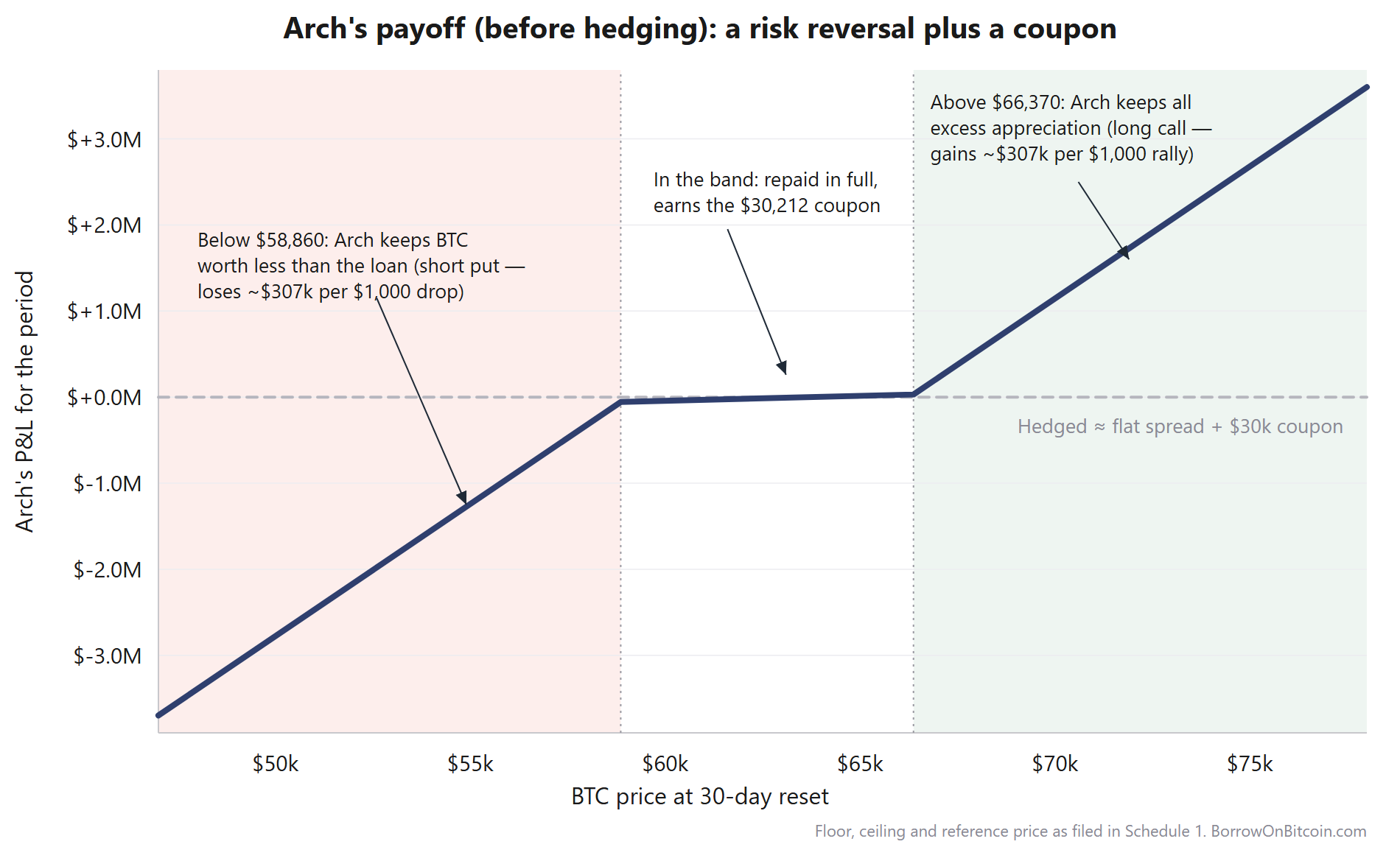
What Arch got: a 2% coupon plus a call on 307 BTC. Together they are worth more than the near-the-money put Arch wrote, because Bitcoin's options market chronically bids calls over puts. Arch is short the put at $58,860 and long the call at $66,370: a risk reversal plus a coupon. The Annex shows Arch never intended to run it naked. Hedge Transactions are expressly defined (options, forwards, swaps, and outright purchases and sales for hedging or funding the collar), with a carve-out from the segregated custody rule for units used in the hedge. Sell the call into the derivatives market, buy the floor protection, and what remains is a market-neutral structuring spread, earned twelve times a year. The hedge itself is our inference; the documents authorize it but do not disclose it.
The payoff curves
Every number in the curves below comes from the filing, including the ceiling.
PowerCompute's curve is the classic collar: hard floor, one-for-one participation in the band, hard cap.
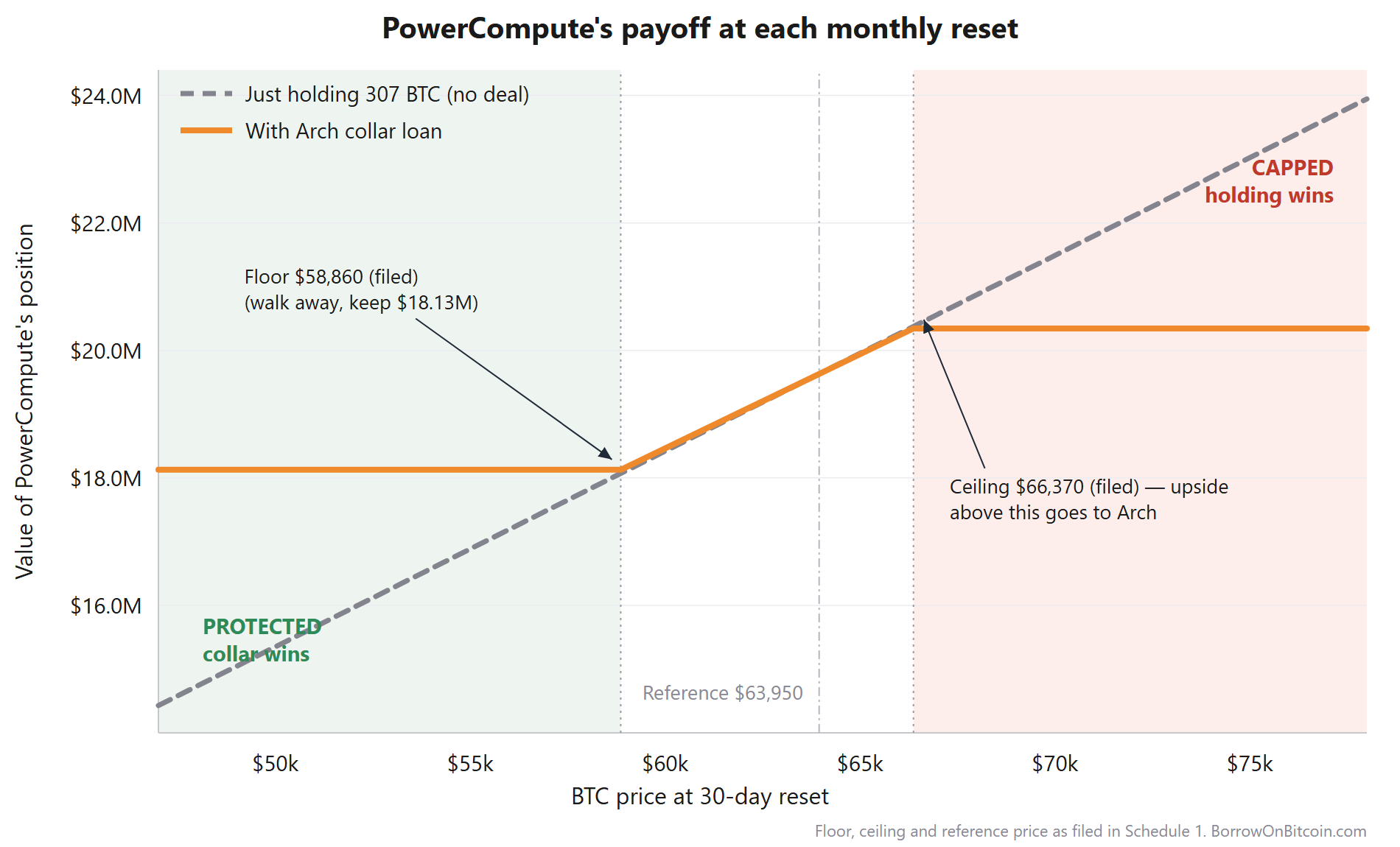
| BTC at reset | Outcome for PowerCompute | Position value |
|---|---|---|
| $50,000 | Walks away. Keeps the $18.13M, surrenders BTC worth $15.35M | $18.13M. Beats holding by $2.78M |
| $58,860 (floor) | Indifference point: walk or repay | About $18.07M |
| $63,950 (reference) | Repays, keeps every coin | About $19.60M. Trails holding only by the $30k coupon |
| $66,370 (ceiling) | Repays, keeps coins. The cap kicks in | About $20.35M |
| $75,000 | Repays. Arch keeps $2.65M of appreciation | $20.35M. Trails holding by $2.68M |
Arch's curve is the mirror image. Arch is not a 2% lender. It is earning a coupon plus a call.
What this means for large Bitcoin holders
This filing is a template. Every corporate treasury, miner, and fund holding size Bitcoin should study it. Four takeaways.
-
TradFi structured lending has arrived on Bitcoin. Concentrated stockholders have used collar financing and variable prepaid forwards for decades to monetize positions without selling. This is that playbook, executed on BTC, disclosed in an SEC filing, with qualified custodians. The precedent is now public and replicable.
-
LTV is negotiable when the lender is hedged. The 50% LTV ceiling in Bitcoin lending was never a law of nature. It was the price of the lender being unhedged. Collar the position and 90%-plus monetization becomes possible. Expect competing lenders to respond.
-
No margin calls is now a real, contractible feature. For a public company, removing the risk of a forced mid-quarter liquidation, and the 8-K that would follow it, may be worth more than the rate itself.
-
The headline rate is not the cost of capital. The true cost is 2% plus the surrendered upside above the ceiling. In a flat or falling month this financing is nearly free. In a monster rally it could be the most expensive debt in the market. Any treasurer modeling this needs an options-aware framework, not a spreadsheet row labeled interest expense.
And for everyone else
Retail borrowers cannot get this deal today. But a detail in the fine print is worth watching. The agreement Arch used is built on its standard consumer lending template, Truth in Lending disclosures and state-by-state provisions included, with the collar bolted on as an annex. The rails to offer collar-style, no-margin-call Bitcoin loans to ordinary borrowers already exist. When that product ships, the trade-off will be the same one PowerCompute made: protection and cheap rates, paid for in upside.
Until then, the standard market of interest-only Bitcoin-backed loans at 40% to 50% LTV is where most borrowers live, and rates there vary widely by lender. That is the market we track daily.
BorrowOnBitcoin compares Bitcoin-backed loan rates across major lenders and maintains the Bitcoin Loan Rate Index. Arch Lending is a BorrowOnBitcoin partner, and BoB users have access to negotiated rate discounts with Arch. All figures are from PowerCompute's Form 8-K dated August 5, 2026 (event date August 3, 2026) and its exhibits, including the executed Schedule 1 Reset Confirmation. Arch has published its own announcement of the financing; the figures and the reading above are ours, taken from the filing. Nothing here is investment, accounting, or tax advice.